
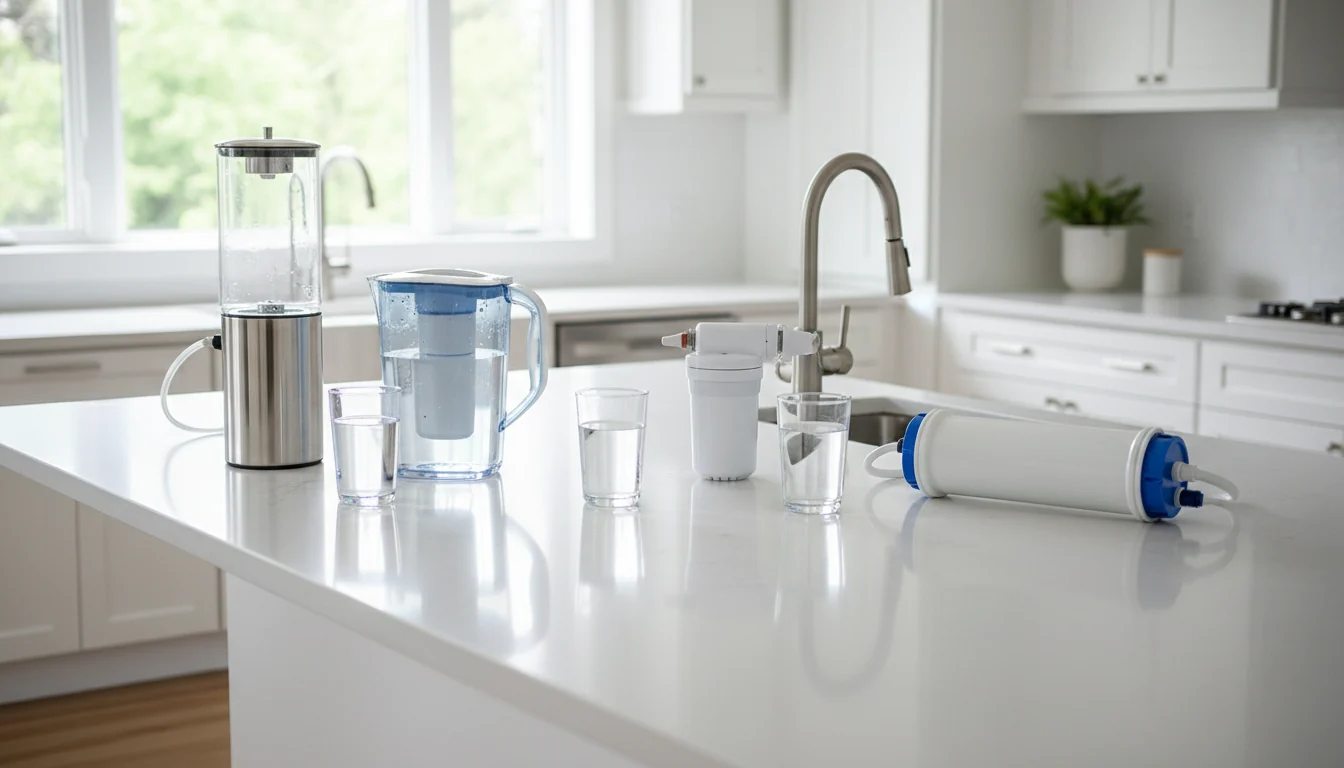
When readers ask me for the best water filters that remove microplastics, I always ask one question first: “What water are you trying to improve?” The right answer for an apartment renter is not always the right answer for a family ready to install an under-sink system.
I’ve tried pitchers, countertop units, faucet filters, and under-sink systems in real kitchens, and I’ve learned that the best water filters that remove microplastics are not always the ones with the loudest claims. I look for pore size, certification, honest data sheets, and maintenance I can actually keep up with.
This guide breaks down the best water filters that remove microplastics by type, use case, and tradeoff. I’ll keep the health claims cautious and the buying advice practical, because cleaner daily water should not require a chemistry degree.
Key Takeaways
- The best microplastic filter is one with clear particle-reduction claims, suitable pore size, and preferably independent certification.
- Reverse osmosis, ultrafiltration, and strong carbon block systems can be good options depending on design and maintenance.
- Pitchers and faucet filters are convenient, but not all are built to reduce tiny particles.
- Filter replacement schedules matter as much as the filter technology.
- Microplastic reduction is useful, but do not ignore other water issues such as lead, PFAS, bacteria, nitrates, or taste.
What “Remove Microplastics” Really Means
Particle Size Matters
Microplastics are tiny plastic fragments, fibers, or particles. Filters reduce particles based partly on pore size, filter structure, and how water moves through the media.
A vague claim like “improves water quality” is not enough. I want to see a micron rating, a tested contaminant list, or a certification that gives the claim structure.
Reduction Is More Honest Than Perfection
I prefer the word “reduce” over “remove everything.” Drinking-water filters are tested under specific conditions, and home results depend on installation, pressure, cartridge age, and water quality.
Certification Helps Cut Through Marketing
NSF/ANSI standards can help verify certain claims, but you still need to read the exact listing. Not every certified filter is certified for the same contaminants.
Filter Types I Consider First
Reverse Osmosis
Reverse osmosis systems push water through a membrane and often include sediment and carbon stages. They are one of my top choices when someone wants broad drinking-water treatment at a dedicated tap.
Ultrafiltration
Ultrafiltration uses a fine membrane to reduce particles while often leaving dissolved minerals mostly in place. It can be a strong choice when microplastic and sediment reduction are priorities.
Carbon Block
Dense carbon block filters can reduce particles and improve taste, depending on their micron rating and design. They are common in countertop, faucet, and under-sink products.
| Filter Type | Why I Like It | What To Check |
|---|---|---|
| Reverse osmosis | Broad reduction, dedicated drinking tap | NSF/ANSI 58 claims, membrane schedule, wastewater ratio |
| Ultrafiltration | Fine particle reduction, usually no wastewater tank | Pore size, flow rate, bacteria claims if any |
| Carbon block | Taste improvement and particle reduction in some designs | Micron rating, NSF listing, cartridge capacity |
Best Use Cases By Household
Apartment Renters
Renters usually need non-permanent options. A countertop gravity filter, certified pitcher, or faucet-mounted filter can be easier than drilling a cabinet.
Homeowners
Homeowners can consider under-sink RO or ultrafiltration. I like under-sink systems because they reduce countertop clutter and make filtered water easy to use for cooking.
Families With Private Wells
Private wells need testing first. If bacteria, nitrates, arsenic, or other issues appear, the filter plan may need professional design. Microplastics may not be the first priority.
Buy the filter for your water, not for the scariest product page.
Comparing Popular Filter Formats
Pitchers
Pitchers are affordable and simple. The downside is limited capacity and inconsistent microplastic claims across models.
Faucet-Mounted Filters
Faucet filters are convenient for renters, but they may slow flow and may not fit every faucet. Check particle claims carefully.
Under-Sink Systems
Under-sink systems take more setup but usually win for daily convenience. My own family drank more filtered water after I installed a dedicated tap because it was always ready.
| Format | Pros | Cons |
|---|---|---|
| Pitcher | Low cost, no installation, fridge-friendly | Small capacity, cartridge discipline needed |
| Faucet mount | Easy access, renter-friendly | Fit issues, flow limitations, variable claims |
| Under-sink | Convenient, higher capacity, cleaner counter | Installation, higher upfront cost, leak checks |
READ MORE Reverse Osmosis Vs Carbon Filters Water Filtration & Treatment
How I Choose A Microplastic Filter
Step List: My Buying Checklist
- Identify your water source: municipal, private well, or bottled refill.
- Read your water report or test your well if needed.
- Decide whether you need particle reduction only or broader treatment.
- Look for micron rating, NSF/ANSI certification, and a performance data sheet.
- Confirm cartridge life and replacement cost before buying.
- Check installation requirements and available space.
Step List: My Installation Check
- Flush the filter exactly as the instructions say.
- Inspect for leaks at every connection.
- Label the install date.
- Taste-test after flushing, not before.
- Set a calendar reminder for replacement.
First-Hand Lesson
The first pitcher filter I used tasted fine for a month, then slowed dramatically because I ignored the cartridge schedule. That taught me that convenience without maintenance is not real convenience.
Costs And Replacement Planning
Upfront Price Bands
Pitchers and faucet filters usually cost the least. Countertop gravity units and under-sink systems cost more. Reverse osmosis systems can be moderate to high depending on stages and installation.
Replacement Cartridges
Always calculate annual filter cost. A cheap unit with expensive cartridges may cost more over time than a better-built system.
Hidden Costs
Under-sink RO may require plumbing adapters, a dedicated faucet hole, or professional installation. Countertop systems may need replacement spigots or seals over time.
| Cost Factor | Low-Cost Option | Higher-Cost Option |
|---|---|---|
| Upfront purchase | Pitcher or faucet mount | Under-sink RO or premium countertop |
| Maintenance | Simple cartridge changes | Multiple stages, membrane, sanitizing |
| Convenience | Manual refills | Dedicated tap or large reservoir |
Care And Maintenance That Protects Performance
Replace On Time
A filter past its rated life may not perform as claimed. I use phone reminders because filter memory disappears fast in a busy kitchen.
Clean Housings
Pitchers, reservoirs, and spigots can collect biofilm if neglected. Wash parts according to the manufacturer’s instructions.
Watch Flow Rate Changes
A sudden slowdown can mean clogging. A sudden speed-up in some systems can indicate bypass or installation problems.
The cartridge schedule is part of the filter, not an optional accessory.
Safety And Health Claims
Microplastics Are Still Being Studied
Microplastics in drinking water are a legitimate concern, but health effects are still an active research area. I reduce avoidable exposure without claiming a guaranteed medical benefit.
This isn’t medical advice — consult a professional if you have health concerns.
Do Not Ignore Certified Claims For Other Contaminants
If your water has lead, PFAS, nitrates, arsenic, or bacteria concerns, choose treatment for those specific issues too. A microplastic-focused filter may not solve them.
Materials Matter
I prefer filters with safe wetted materials, clear replacement parts, and minimal mystery plastic in the water path. Glass reservoirs and stainless housings can be nice, but the tested filtration claim matters most.
Environmental Impact
Fewer Disposable Bottles
A dependable home filter can reduce reliance on single-use bottled water. That was the biggest environmental improvement I noticed after switching to an under-sink tap.
Cartridge Waste Still Exists
Filters create spent cartridges. Choose realistic capacity and avoid tiny cartridges if your household drinks a lot of water.
Durable Systems Win
A repairable housing with available replacement parts is better than a gadget that becomes trash when one lid breaks.
READ MORE Best Glass Water Bottles For Filtered Water Bottled Water & Safer Bottles
Brands, Claims, And What I Do Not Trust
I Trust Data More Than Big Promises
I do not recommend a brand just because it says “lab tested.” I look for the actual contaminant list, test method, certification body, and replacement schedule.
Red Flags
Be cautious with filters that promise to remove every contaminant, never need replacement, or use scientific-sounding language without a data sheet.
Good Signs
Good signs include clear NSF/ANSI listings, transparent capacity claims, accessible manuals, and replacement cartridges that are easy to buy.
If a company hides the performance sheet, I do not let that filter hide under my sink.
Is A Microplastic Filter Right For You?
Good Fit
A microplastic-reducing filter makes sense if you want to reduce disposable bottled water, improve taste, and cut particle exposure from daily drinking water.
Not The Only Question
It may not be the first priority if your water has microbial contamination, lead service lines, PFAS, or private-well issues. Start with the most important risk.
Check pitcher, countertop, and under-sink water filter options before deciding what fits your home best.
As an Amazon Associate, Clean Water In Homes may earn from qualifying purchases.
My Practical Recommendation
For many homes, a certified under-sink RO or ultrafiltration system is the strongest daily option. Renters may do better with a high-quality countertop or pitcher filter that has clear particle claims.
FAQ
Do pitcher filters remove microplastics?
Some may reduce certain particles, but not all do. Check the performance data sheet and micron rating rather than assuming.
Is reverse osmosis best for microplastics?
Reverse osmosis can be excellent for particle reduction and broader contaminant reduction, but it needs maintenance and proper installation.
What micron rating should I look for?
Smaller micron ratings generally capture smaller particles, but design and testing matter. Look for verified particle reduction claims.
Can a filter add microplastics?
Any plastic water-contact part can be a contact point, especially if damaged or poorly made. Choose reputable systems and replace worn parts.
Conclusion
My Personal Considerations
When I choose among the best water filters that remove microplastics, I balance certification, convenience, cost, and maintenance. A perfect filter on paper is useless if nobody replaces the cartridge.
My Final Recommendation
Start with your water report, pick a filter type that fits your home, and verify claims before you buy. For daily drinking water, I lean toward certified under-sink RO or ultrafiltration when the budget and space allow.