
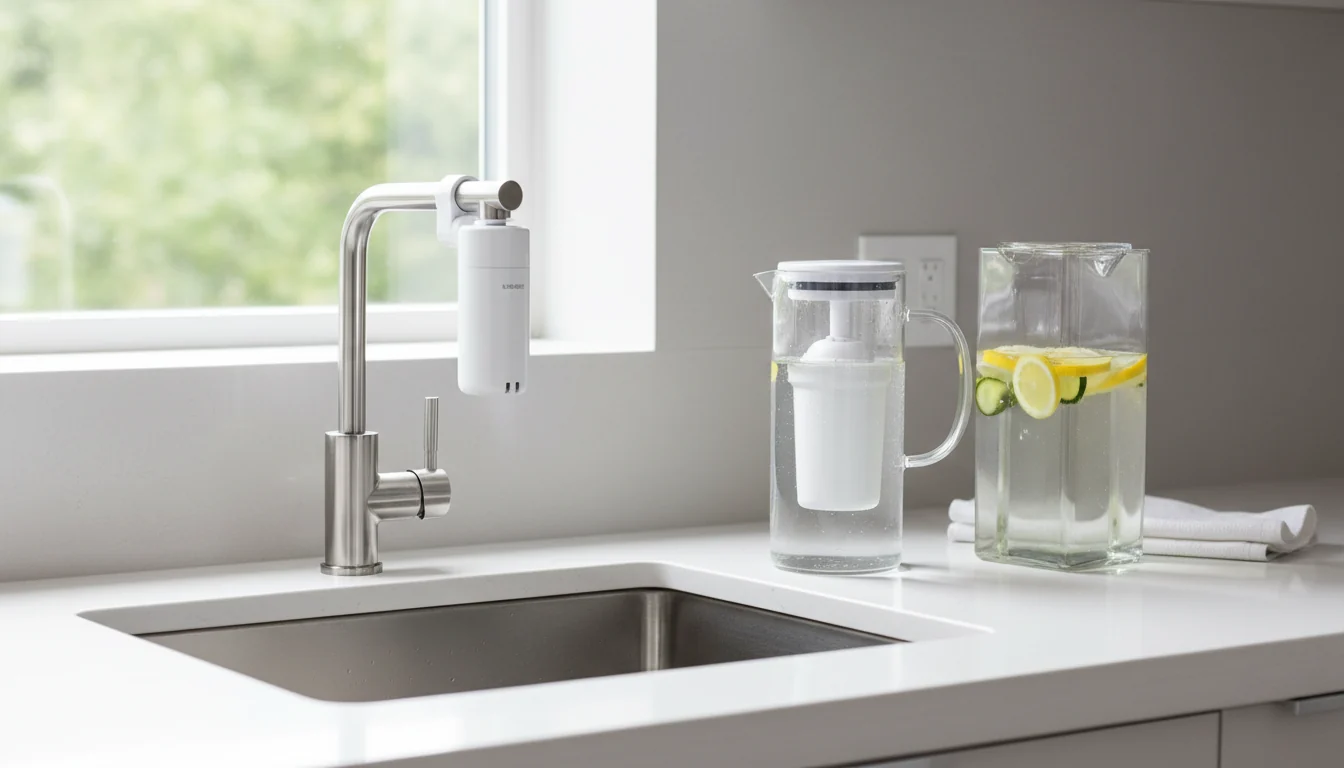
Quick comparison
A faucet filter is usually better if you want filtered water on demand for cooking, coffee, and filling bottles. A water filter pitcher is usually better if you want the simplest setup, lower upfront cost, and cold filtered water in the fridge. Both can improve taste, but the best choice depends on your sink, habits, and patience for maintenance.
I have used both styles, and I do not think one wins for every home. The faucet filter feels convenient when I am cooking. The pitcher feels easy when I want chilled water without changing the sink hardware. The trick is matching the filter to the way you actually use water every day.
How faucet filters work
A faucet-mounted filter attaches directly to the end of a compatible kitchen faucet. Most let you switch between regular tap water and filtered water. That matters because you do not need filtered water for washing dishes, but you may want it for drinking and cooking.
Many faucet filters use activated carbon and sometimes additional media to reduce chlorine taste, odors, and certain contaminants depending on the model. Always read the specific performance sheet rather than assuming every faucet filter does the same job.
How filter pitchers work
A pitcher filter sits in the reservoir of a pitcher. You fill the top, water passes through the cartridge by gravity, and filtered water collects below. Pitchers are popular because they require no tools, no faucet compatibility check, and no plumbing changes.
The tradeoff is speed and capacity. If a pitcher is empty when you need water for pasta, coffee, or a family dinner, you have to wait.
Taste and contaminant reduction
Both styles can improve taste when chlorine is the main complaint. The difference is less about the category and more about the specific cartridge. Some pitchers are basic taste-and-odor filters. Others target more contaminants. Some faucet filters have strong certifications, while others make broad claims without much detail.
I look for NSF or ANSI standards when available. Standard 42 relates to aesthetic effects like chlorine taste and odor. Standard 53 covers certain health-related contaminants. Standard 401 covers some emerging compounds. You do not need to memorize every standard, but you should compare real claims rather than package language.
Speed and convenience
Faucet filters win on speed. Turn the lever and fill a glass, pot, or bottle. For a family kitchen, that can be the difference between using the filter and ignoring it.
Pitchers win on grab-and-go simplicity. The water is already cold if you keep the pitcher in the fridge. That is nice for a desk bottle or school bottle routine. Just remember that someone has to refill it. In many homes, the pitcher is always empty because everyone assumes someone else will do it.
Installation and compatibility
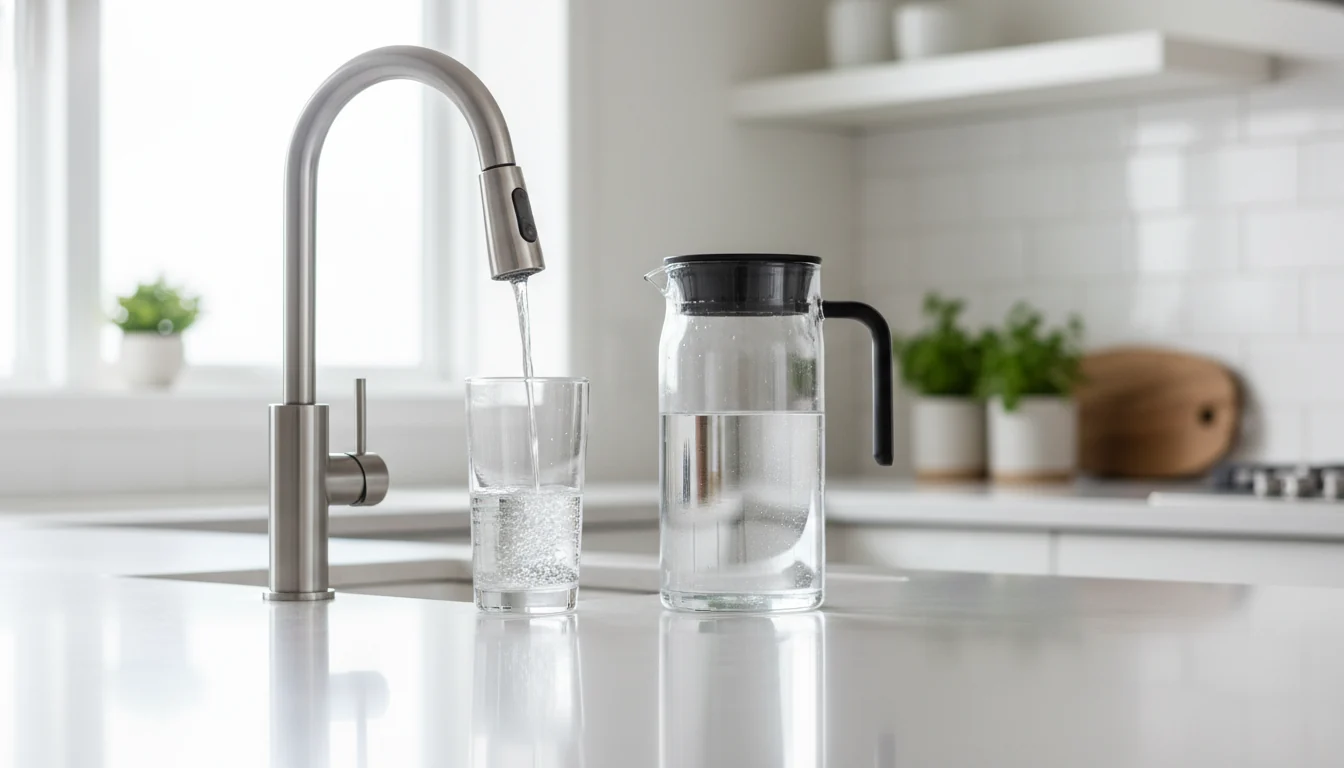
Pitchers work almost anywhere. Faucet filters do not. Pull-down sprayers, unusual faucet threads, and designer faucets can make installation difficult or impossible. If you rent, a faucet filter is still usually removable, but you need to keep the original aerator and any small adapter parts.
Before buying a faucet filter, check your faucet style. If the end of the faucet does not unscrew or uses a nonstandard sprayer head, choose a pitcher or countertop filter instead.
Counter space and fridge space
A faucet filter lives on the sink, so it takes no fridge space. It can look bulky, and on a small sink it may get in the way. A pitcher takes fridge space, and larger dispensers can crowd shelves.
In a small apartment, I usually choose based on which space is more precious. If the fridge is tiny, a faucet filter may be easier. If the sink is small or the faucet is not compatible, a slim pitcher is safer.
Cost over time
Pitchers often have a low starting price. Faucet filters can cost a little more upfront, but cartridge life varies widely. The real cost is replacement filters. Check how many gallons each cartridge is rated for and how much replacements cost.
Do not stretch cartridges far beyond the schedule to save money. Once a filter is exhausted, taste can return and performance may drop.
Maintenance
Pitchers need regular washing. The lid, reservoir, and spout can collect residue if ignored. Faucet filters need cartridge changes and occasional wiping around the connection. If flow slows dramatically, the cartridge may be clogged.
I like writing the replacement date on tape and sticking it under the sink or on the pitcher lid. It is not fancy, but it works.
Which one should you choose?
Choose a faucet filter if you cook often, fill bottles from the sink, want faster flow, have a compatible faucet, and do not mind a visible attachment. Choose a pitcher if you want no installation, chilled water, easy portability, or a filter you can use in a dorm, rental, or shared kitchen.
For some homes, both make sense: faucet filter for cooking and a pitcher for cold water. But I would start with the one that solves your biggest daily annoyance.
FAQ
Is a faucet filter better than a pitcher?
It is better for speed and sink-side convenience. It is not automatically better for contaminant reduction; that depends on the cartridge and certifications.
Do pitchers remove hard water minerals?
Most standard pitchers do not truly soften water. Some specialty filters reduce total dissolved solids, but you should check the product data.
Can I use a faucet filter in an apartment?
Often yes, if the faucet is compatible and installation is reversible. Keep all original parts.
Which is easier to clean?
Faucet filters require less washing, while pitchers need regular cleaning of the container. Pitchers are simpler mechanically, but easier to neglect.
My bottom line
In the faucet filter vs water filter pitcher debate, I lean faucet filter for busy kitchens and pitchers for low-commitment simplicity. Either can be a good choice if the filter claims match your water concerns and you keep up with cartridge changes.