
Best water filters for apartments
The best water filter for an apartment is the one that improves the water you actually use, fits your lease, and does not require plumbing changes you cannot undo. For most renters, that means starting with a pitcher, faucet-mounted filter, countertop system, or non-permanent under-sink filter. If your main complaint is dry skin or chlorine smell in the shower, a shower filter may also be worth considering.
Apartment water filtration is different from whole-house filtration. You usually do not control the building’s main plumbing. You may not be allowed to cut pipes, drill into counters, install a large tank, or add equipment that could leak into a downstairs unit. Space is limited, and moves happen. A great apartment filter should be compact, reversible, easy to maintain, and matched to the contaminants you care about.
My short recommendation: choose a certified pitcher or countertop filter if you want the lowest-risk rental option, a faucet-mounted filter if you want convenience, and an under-sink system only if your lease and plumbing setup make it easy to remove later.
What apartment renters should look for first
Before comparing brands, answer four questions.
1. What problem are you trying to solve?
Different filters solve different problems. A filter that makes tap water taste better may not reduce lead. A shower filter is not a drinking-water filter. A sediment filter does not make unsafe water safe from microbes.
Common apartment water complaints include:
- Chlorine taste or smell.
- Cloudiness from air bubbles or fine particles.
- Old-building concerns such as lead from plumbing components.
- Hard-water scale on kettles and fixtures.
- Dry-feeling skin or strong shower odor.
- Small black specks, rust-colored particles, or sediment.
- General preference for better-tasting drinking water.
If you have a specific health concern, avoid vague marketing. Look for the exact contaminant in the product’s certification or test data.
2. What can your lease tolerate?
Many renters can use pitchers, dispensers, gravity filters, countertop filters, and faucet-mounted filters without asking. Anything that changes plumbing under the sink, adds a drain saddle, drills a hole, or connects to a refrigerator line may require permission.
A good renter rule is: if you cannot remove it in 15 minutes and leave no trace, check the lease first. This is especially true in multi-unit buildings where leaks can become expensive.
3. How much space do you have?
Small apartments make every inch count. A large countertop system may perform well but feel annoying if it takes over your only prep area. A pitcher may be easy but steal refrigerator space. An under-sink unit may save counter space but crowd cleaning supplies and complicate move-out.
Think about the filter’s footprint, not just its performance claims.
4. Will you keep up with replacement filters?
The best filter is only useful if you maintain it. Replacement cartridges can cost more than expected, and some systems require brand-specific filters. Before buying, check cartridge price, replacement interval, availability, and whether the model uses a reminder light or app.
Best apartment water filter types
Here are the most renter-friendly categories, with where each one works best.
Best overall for most renters: water filter pitcher or dispenser
A pitcher is the easiest apartment water filter to recommend because it requires no installation. Fill it from the tap, let water pass through the cartridge, and store it on the counter or in the fridge. Larger dispensers work the same way but hold more water.
Pitchers are best for:
- Renters who want no plumbing changes.
- Small households.
- Dorms and studios.
- People who mainly filter drinking and cooking water.
- Anyone who moves often.
The tradeoff is speed and capacity. Pitchers can be slow, and you have to refill them. A family or shared apartment may empty a small pitcher constantly. If you cook a lot, make coffee, fill bottles, and use filtered water for pets, a dispenser may be more practical than a slim pitcher.
Look for a pitcher or dispenser with certification for the contaminants you care about. Some focus on chlorine taste and odor. Others are designed for broader reduction claims, such as lead or certain PFAS compounds. Do not assume all cartridges from the same brand perform the same way.
Pros:
- No tools or landlord approval usually needed.
- Low upfront cost.
- Easy to move.
- Simple replacement process.
- No leak risk from plumbing connections.
Cons:
- Limited capacity.
- Can be slow.
- Takes counter or refrigerator space.
- Requires frequent cartridge changes in heavy-use homes.
Best for convenience: faucet-mounted water filter
A faucet-mounted filter attaches directly to the end of your kitchen faucet. Most let you switch between filtered and unfiltered water, which helps preserve cartridge life when washing dishes.
This is a strong apartment option if you want filtered water on demand but do not want an under-sink system. It is especially useful for people who fill coffee makers, pots, and bottles throughout the day.
Before buying, check your faucet. Faucet filters usually need a standard round faucet with a removable aerator. They may not work with pull-down sprayers, unusual designer faucets, square faucet ends, or faucets with built-in sensors.
Pros:
- Filtered water on demand.
- Usually removable without permanent changes.
- Does not take refrigerator space.
- Good for cooking water.
Cons:
- Not compatible with every faucet.
- Can look bulky.
- Small cartridges may need frequent replacement.
- May reduce flow.
- Added weight can stress a weak faucet.
If your faucet is old, loose, or already leaking, fix that first or choose a pitcher instead. A renter-friendly filter should not create a maintenance issue with the landlord.
Best for no-install higher capacity: countertop gravity filter
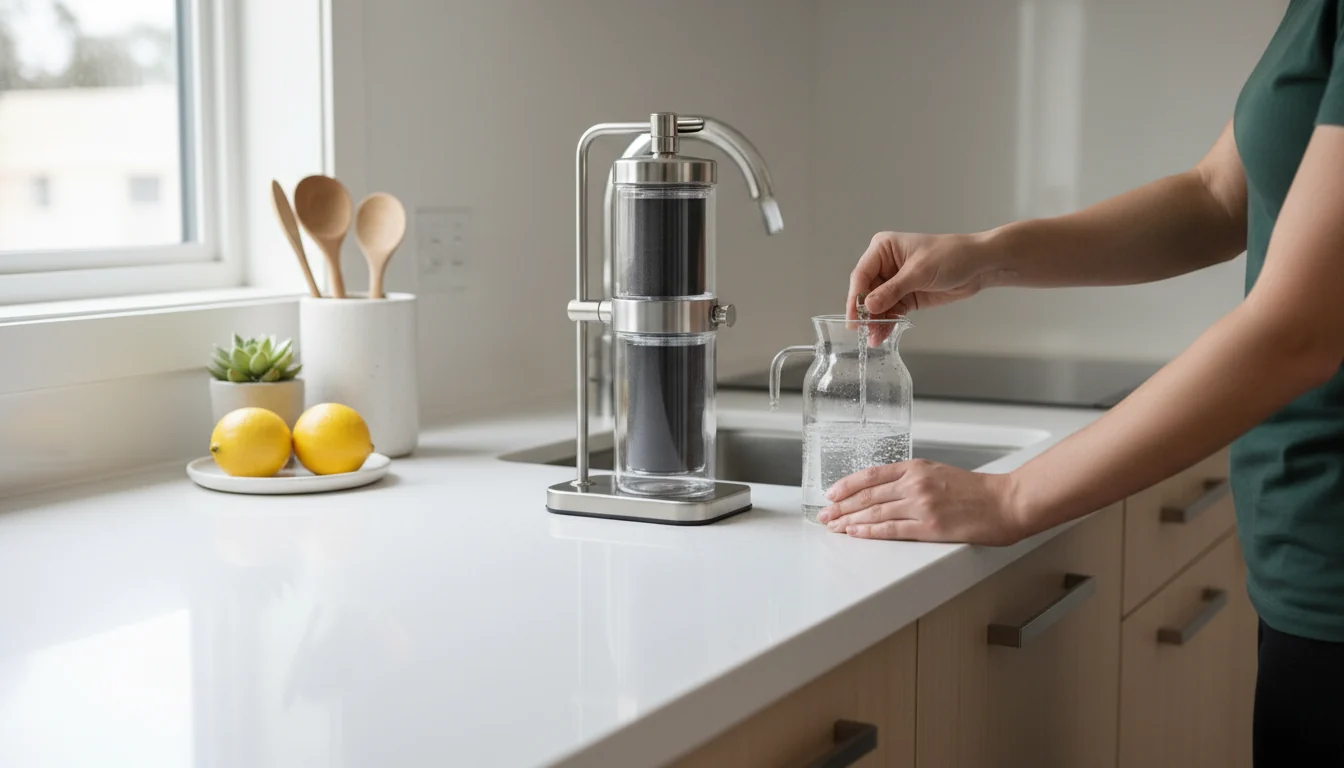
Countertop gravity filters use an upper chamber, filter elements, and a lower storage chamber. You pour water in, and gravity pulls it through the filter media. These systems are popular with people who want more capacity than a pitcher without attaching anything to plumbing.
They can be a good fit for apartments with enough counter space and households that drink a lot of water. They are also easy to take with you when you move.
The main caution is certification and claims. Countertop gravity systems vary widely. Some have strong independent testing for specific contaminants; others rely on broad marketing language. If you are buying for a specific issue, read the performance data carefully.
Pros:
- No faucet compatibility problem.
- More capacity than many pitchers.
- Portable.
- No plumbing leak risk.
- Good for households that refill bottles often.
Cons:
- Takes counter space.
- Can be slow to refill.
- Requires cleaning.
- Performance claims vary by brand and filter element.
- Upfront cost may be higher than a pitcher.
A countertop gravity system makes the most sense when you have a stable counter spot and prefer a stand-alone setup over faucet attachments.
Best for small kitchens: compact countertop faucet-connected filter
Some countertop filters sit beside the sink and connect to the faucet with a diverter valve. When you turn the diverter, water flows through the filter and out a small spout on the unit.
These systems can offer more filter media and capacity than a faucet-mounted filter while still avoiding under-sink installation. They are easier to remove than permanent plumbing systems, but they do attach to the faucet, so compatibility matters.
Pros:
- Often better capacity than small faucet filters.
- No under-sink plumbing changes.
- Filtered water on demand.
- Easy to take when moving.
Cons:
- Uses counter space.
- Visible hose and diverter.
- May not fit pull-down or non-standard faucets.
- Not ideal if the sink area is cramped.
For renters who cook often but do not want to modify cabinets, this can be a practical middle ground.
Best if allowed: renter-friendly under-sink filter
An under-sink filter connects to the cold-water line and sends filtered water to your existing faucet or a separate faucet, depending on the design. For apartments, the safest options are systems that connect with reversible fittings and do not require drilling.
Under-sink filters are attractive because they save counter space and can provide good flow and capacity. But they also introduce the biggest rental concerns: leaks, lease restrictions, installation mistakes, and move-out removal.
Consider an under-sink filter only if:
- Your lease allows it or your landlord approves it.
- You can install it without drilling permanent holes.
- The cold-water valve and supply line are accessible and in good condition.
- You are comfortable checking for leaks after installation.
- You can restore the original setup when you move.
Pros:
- Saves counter and fridge space.
- Often higher capacity.
- Convenient for daily cooking and drinking.
- Hidden installation.
Cons:
- May require permission.
- Leak risk if installed poorly.
- Not ideal for very old or corroded plumbing.
- More work to remove during move-out.
If you go this route, keep the original supply line parts in a labeled bag. Take photos before installation so you can put everything back exactly as it was.
Best for broad filtration when plumbing is allowed: reverse osmosis
Reverse osmosis systems can reduce a wide range of dissolved substances and are often chosen when taste, total dissolved solids, or specific contaminants are concerns. However, traditional RO systems are not always apartment-friendly. They may require a storage tank, drain connection, dedicated faucet, and more under-sink space.
For renters, countertop RO units may be more practical than under-sink RO systems because some do not require permanent installation. They do take counter space and may need manual filling, but they avoid drilling and drain saddles.
RO is worth considering if you have a specific reason for it and understand the maintenance. It is probably more than you need if your only complaint is light chlorine taste.
Pros:
- Can address a broad range of dissolved contaminants when properly designed and maintained.
- Often improves taste significantly.
- Countertop versions may be renter-friendly.
Cons:
- Higher upfront cost.
- Slower production than simple carbon filters.
- Requires filter and membrane maintenance.
- Some systems waste water during operation.
- Under-sink versions may conflict with lease terms.
For apartment use, I would look first at countertop RO if you cannot modify plumbing, then under-sink RO only with clear permission.
Best for shower complaints: shower filter
A shower filter is not a drinking-water solution, but it may help if your main issue is chlorine smell or sediment at the showerhead. These filters attach between the shower arm and showerhead or come built into a replacement showerhead.
They are usually renter-friendly because they screw on and off, but you should avoid over-tightening and keep the original showerhead if you replace it.
Pros:
- Easy to install and remove.
- Targets shower odor and some sediment concerns.
- Does not affect kitchen setup.
- Good for renters who dislike strong chlorine smell in hot showers.
Cons:
- Not for drinking water.
- Hot water can reduce performance for some media.
- Replacement schedules are easy to ignore.
- Claims vary widely.
If your skin or hair concerns are serious, remember that water is only one possible factor. A shower filter may help with odor or feel, but it is not a medical treatment.
Apartment filter comparison
- Pitcher or dispenser
- Best for: lowest-risk rental use.
- Installation: none.
- Space needed: fridge or counter.
-
Watch out for: slow refills and cartridge cost.
-
Faucet-mounted filter
- Best for: filtered water on demand.
- Installation: attaches to faucet aerator.
- Space needed: minimal.
-
Watch out for: faucet compatibility.
-
Countertop gravity filter
- Best for: higher capacity without plumbing.
- Installation: none.
- Space needed: counter.
-
Watch out for: certification details and cleaning.
-
Countertop faucet-connected filter
- Best for: cooking water without under-sink work.
- Installation: faucet diverter.
- Space needed: counter near sink.
-
Watch out for: visible hose and faucet fit.
-
Under-sink filter
- Best for: hidden daily-use filtration.
- Installation: cold-water line connection.
- Space needed: under sink.
-
Watch out for: lease terms and leaks.
-
Countertop or under-sink reverse osmosis
- Best for: broader dissolved contaminant reduction.
- Installation: varies from none to involved.
- Space needed: counter or under sink.
-
Watch out for: cost, maintenance, and wastewater.
-
Shower filter
- Best for: shower odor and sediment complaints.
- Installation: shower arm connection.
- Space needed: none on counter.
- Watch out for: not a drinking-water filter.
Certification matters more than marketing
For apartment water filters, certification can prevent expensive disappointment. Look for NSF/ANSI standards or credible third-party testing tied to the exact model and cartridge.
Common examples include:
- NSF/ANSI 42: aesthetic effects such as chlorine taste and odor.
- NSF/ANSI 53: certain health-related contaminants, depending on the specific claim.
- NSF/ANSI 58: reverse osmosis systems.
- NSF/ANSI 401: certain emerging compounds, depending on the claim.
The standard number alone is not enough. Check which contaminants are actually covered. A product may be certified under a standard for one claim but not for every contaminant associated with that standard.
If you live in an older building and worry about lead, choose a filter specifically certified or tested for lead reduction. If you worry about PFAS, look for PFAS-specific claims. If your water comes from a private well, apartment-style filters may not be enough without testing and a broader treatment plan.
What about hard water in apartments?
Hard water is common, and many renters notice scale on kettles, glassware, shower doors, and faucets. Most standard carbon filters do not soften water. They may improve taste and reduce chlorine, but they generally do not remove enough calcium and magnesium to stop scale.
If hard water is your main issue, your options are more limited in an apartment:
- A pitcher with ion exchange resin may reduce some hardness temporarily, depending on design.
- A countertop distiller can remove minerals but is slow and uses electricity.
- Reverse osmosis can reduce dissolved minerals at a drinking-water tap.
- A true whole-home softener is usually not renter-friendly.
For scale in a kettle, filtering drinking water through RO or using a suitable pitcher may help for that specific use. For shower scale throughout the apartment, you likely need building-level treatment, which renters usually cannot install.
Best choice by renter situation
If you are in a studio or dorm
Choose a compact pitcher or small dispenser. You probably want the simplest setup with no installation and no argument with building rules. If refrigerator space is tight, choose a countertop dispenser or slim pitcher.
If you cook every day
Consider a faucet-mounted filter or countertop faucet-connected system. Pitchers can be frustrating when you need several quarts of filtered water for soup, pasta, coffee, or meal prep.
If your faucet is not compatible
Choose a pitcher, dispenser, gravity countertop filter, or countertop RO unit that does not connect to the faucet. Pull-down sprayer faucets are a common reason faucet filters do not work.
If you share an apartment
Choose a larger dispenser, gravity system, or higher-capacity countertop filter. A small pitcher will always be empty if several people use it.
If you move often
Avoid anything under the sink unless it is extremely easy to remove. A pitcher, dispenser, or gravity system is easier to pack and less likely to create move-out headaches.
If you are worried about lead in an older building
Do not rely on taste. Use a filter specifically certified or tested for lead reduction, follow the replacement schedule closely, and consider having the water tested. Lead risk can depend on building plumbing, service lines, fixtures, and water chemistry.
If you want the cleanest-looking setup
A permitted under-sink filter is the cleanest day-to-day option because it hides the cartridge and does not occupy the counter. Just make sure it is allowed and installed carefully.
Installation tips for renters
A few careful steps can save you from leaks and deposit disputes.
- Read the lease before installing anything connected to plumbing.
- Photograph the original faucet, supply line, and under-sink area.
- Keep all original parts in a labeled bag.
- Avoid drilling unless you have written permission.
- Hand-tighten plastic fittings first; do not force threads.
- Check for leaks immediately, then again after 10 minutes, one hour, and the next day.
- Place a small leak tray or moisture alarm under sink systems if allowed.
- Replace filters on schedule so housings do not clog and stress fittings.
For any under-sink installation, know where the shutoff valve is before you start. If the valve does not fully close, stop and contact maintenance rather than forcing the project.
Maintenance costs to check before buying
A cheap filter can become expensive if cartridges cost a lot or need frequent replacement. Before choosing a system, calculate the first year of ownership:
- Upfront unit cost.
- Number of replacement cartridges needed per year.
- Cost per cartridge set.
- Shipping or local availability.
- Any extra parts, such as membranes, O-rings, or mineral cartridges.
Also consider inconvenience. A filter that technically costs less but clogs quickly or requires constant refilling may not be the best choice for your apartment.
My practical apartment filter ranking
If I were choosing for a typical renter, I would rank the options this way:
- Certified pitcher or dispenser for the safest no-install choice.
- Faucet-mounted filter if the faucet is compatible and convenience matters.
- Countertop gravity filter for higher capacity without plumbing.
- Countertop faucet-connected filter for frequent cooking water.
- Countertop reverse osmosis for renters who specifically want RO without permanent installation.
- Under-sink filter only when lease terms and plumbing conditions are favorable.
- Shower filter as a separate add-on for shower-specific complaints.
This is not a performance ranking for every contaminant. It is a renter-practicality ranking. The right answer still depends on your water, your lease, and how much filtered water you use.
Final recommendation
For most apartments, start simple. A well-chosen pitcher, dispenser, or countertop filter can make daily drinking water better without touching the plumbing. If you need more convenience, move up to a faucet-mounted or countertop connected filter. Save under-sink systems and reverse osmosis for situations where the lease, space, and maintenance requirements all make sense.
The biggest mistake is buying the most complicated system before knowing the problem. Check your water report if you are on a public supply, test if you have a specific concern, and match the filter to the contaminant—not just the word “clean” on the box.