How often should you replace a water filter?
Most home water filters should be replaced on a schedule based on water use, filter type, and the manufacturer’s rated capacity—not on the calendar alone. A small pitcher filter might need a new cartridge every month or two in a busy household, while a whole-house sediment filter may last several months, and some reverse osmosis membranes can last years when the prefilters are changed on time.
The tricky part is that “how often” is not one universal answer. Two homes can own the same filter and get very different lifespans from it. A couple using filtered water mostly for drinking may get far more time from a cartridge than a family of five that uses the same system for cooking, coffee, pets, and ice. Homes with visible sediment, high chlorine, iron staining, or hard water may also shorten the useful life of certain filters.
Here is the practical rule I use: start with the manufacturer’s replacement interval, then adjust based on flow rate, taste, odor, water quality, and actual gallons used. If your water starts tasting different, the flow slows down, or the filter has reached its gallon rating, it is time to replace it.
Quick replacement guide by filter type
Use this as a starting point, then check your specific model. Filter designs vary, and the label or manual should always win over a general guideline.
- Water filter pitchers: commonly every 1–3 months, depending on cartridge rating and household use.
- Faucet-mounted filters: commonly every 2–4 months.
- Refrigerator water filters: often every 6 months, though heavy use can require earlier replacement.
- Under-sink carbon filters: commonly every 6–12 months.
- Countertop gravity filters: carbon elements may last months or longer depending on the system and contaminant load; follow the brand’s gallon rating closely.
- Reverse osmosis prefilters and carbon postfilters: commonly every 6–12 months.
- Reverse osmosis membrane: often every 2–5 years, depending on water quality, usage, and maintenance.
- Whole-house sediment filters: commonly every 1–6 months.
- Whole-house carbon filters: commonly every 6–12 months, though tank-style systems may have longer service intervals.
- UV system lamps: typically replaced annually, even if the lamp still glows, because output can decline over time.
These ranges are intentionally broad. A filter’s rated gallons matter more than a generic timeline. If a cartridge is rated for 200 gallons and your household uses 3 filtered gallons per day, that is roughly 67 days of use before the cartridge reaches its rated capacity. If you use 8 gallons per day, the same cartridge may be due in about 25 days.
Why filter replacement timing matters
A water filter is not a permanent barrier. Most cartridges contain media—such as activated carbon, sediment layers, ion exchange resin, or membrane material—that has a finite capacity. As the media loads up with particles or chemicals, performance can drop.
Changing a filter late can lead to a few practical problems:
- Reduced flow: sediment and trapped material can clog the filter.
- Taste and odor returning: carbon can become less effective after its useful life.
- Stress on the system: clogged prefilters can reduce pressure and make connected components work harder.
- Uncertainty about performance: once the filter exceeds its tested or rated capacity, you no longer have a good basis for assuming it is performing as intended.
This does not mean every overdue filter suddenly becomes dangerous. It does mean the filter may not be doing the job you bought it to do. If your water concern is health-related—lead, PFAS, nitrates, bacteria, or another specific contaminant—replacement timing becomes more important because you are relying on tested performance, not just better taste.
The three numbers to check first
Before you guess, look for three details on the product packaging, manual, or manufacturer website.
1. Rated gallons
This is the most useful number. It tells you how much water the filter is designed to treat under test conditions. A cartridge rated for 40 gallons and one rated for 600 gallons should not be treated the same, even if they look similar.
If the filter has a gallon rating, estimate your use:
- Drinking water: 0.5–1 gallon per person per day is a reasonable planning estimate for many homes.
- Cooking, coffee, tea, pets, and ice: add more if these all run through the same filter.
- Whole-house filters: consider total household water use, not just drinking water.
You do not need perfect math. A rough estimate is enough to avoid being months off schedule.
2. Time limit
Many filters also list a maximum time, such as “replace every 6 months.” This matters even if you have not reached the gallon rating. Filters sit wet after installation, and wet environments can change over time. Manufacturers set time limits to help keep performance predictable.
For a vacation home, RV, or rarely used apartment, do not assume the cartridge is fine just because not much water passed through it. Check the manufacturer’s instructions for storage, flushing, and replacement after long periods without use.
3. Certified contaminant claims
If you bought a filter for a specific concern, confirm the filter is certified or tested for that concern and maintain it according to those instructions. A carbon filter that improves taste is not automatically a lead filter. A reverse osmosis system is not maintenance-free. A sediment filter does not disinfect water.
Look for applicable NSF/ANSI standards or manufacturer test data for the contaminant you care about. Then keep the replacement schedule aligned with that performance claim.
Signs your water filter needs replacement
A schedule is best, but your senses and system behavior can also warn you.
Common signs include:
- Flow rate drops noticeably. The faucet, pitcher, dispenser, or refrigerator fill becomes slow.
- Taste changes. Chlorine taste, stale flavor, metallic notes, or “flat” water returns.
- Odor comes back. A carbon filter that used to reduce odor may be exhausted.
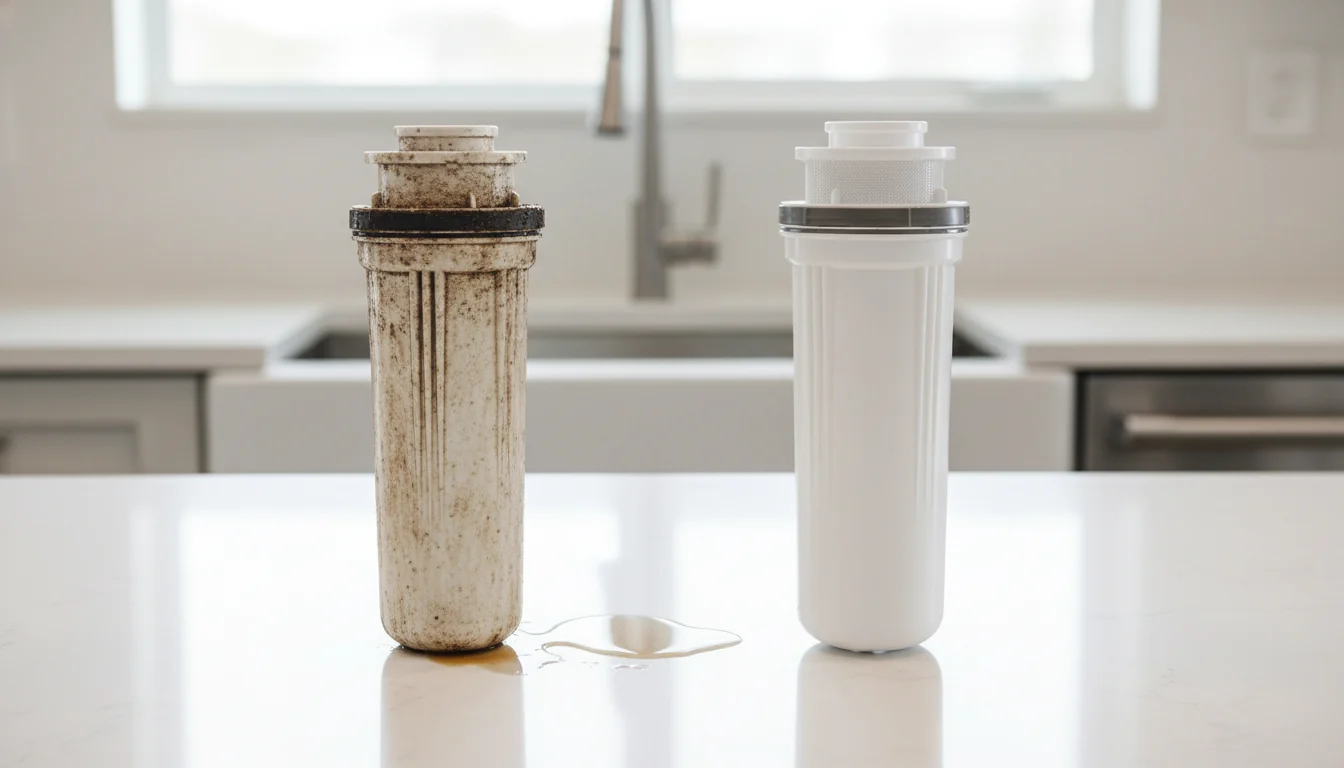
- The filter looks dirty. This is especially obvious with clear housings or sediment filters.
- The system makes unusual sounds. Some RO systems may run longer or behave differently if prefilters are clogged.
- Indicator light turns on. Refrigerator and faucet filters often track time or flow.
- You cannot remember the last replacement. If no one in the home knows, treat it as due.
For taste and odor filters, a noticeable change is a strong signal. For contaminants you cannot taste or smell, such as lead or nitrate, do not wait for sensory clues. Follow the schedule and consider testing where appropriate.
Replacement intervals for common home filters
Here is a more detailed look at the filter types most homeowners and renters ask about.
Pitcher filters
Pitcher filters are easy to forget because they keep working physically even when the cartridge is past its best life. The water may still pass through, but the media may no longer reduce taste, odor, or specific contaminants as claimed.
If your pitcher has an electronic reminder, use it—but understand what it measures. Some reminders are simple timers. Others estimate pours. If your household refills the pitcher many times per day, a timer may understate actual use.
A good habit is to write the installation date on the cartridge wrapper or keep a note on your phone. For a busy kitchen, monthly replacement is not unusual. For one person using it lightly, a longer interval may be fine if it matches the rated gallons.
Faucet-mounted filters
Faucet filters often include a small carbon cartridge in a compact housing. Their convenience is also their limitation: the cartridge is small, so capacity is usually limited compared with larger under-sink systems.
Replace these when the indicator says to, when flow slows, or when the rated gallons are reached. If your faucet filter is used for cooking pots of pasta, filling bottles, coffee, and pet bowls, it may reach capacity faster than expected.
Refrigerator filters
Many refrigerator filters are replaced every six months by default, but actual timing depends on ice use, dispenser use, and water quality. A refrigerator reminder light is helpful, but it may be based on time rather than real gallons.
Do not ignore installation instructions. Many fridge filters require flushing after replacement to clear carbon fines and trapped air. Also make sure the replacement cartridge is compatible. Poor fit can cause leaks or bypass, which means water may not be treated as intended.
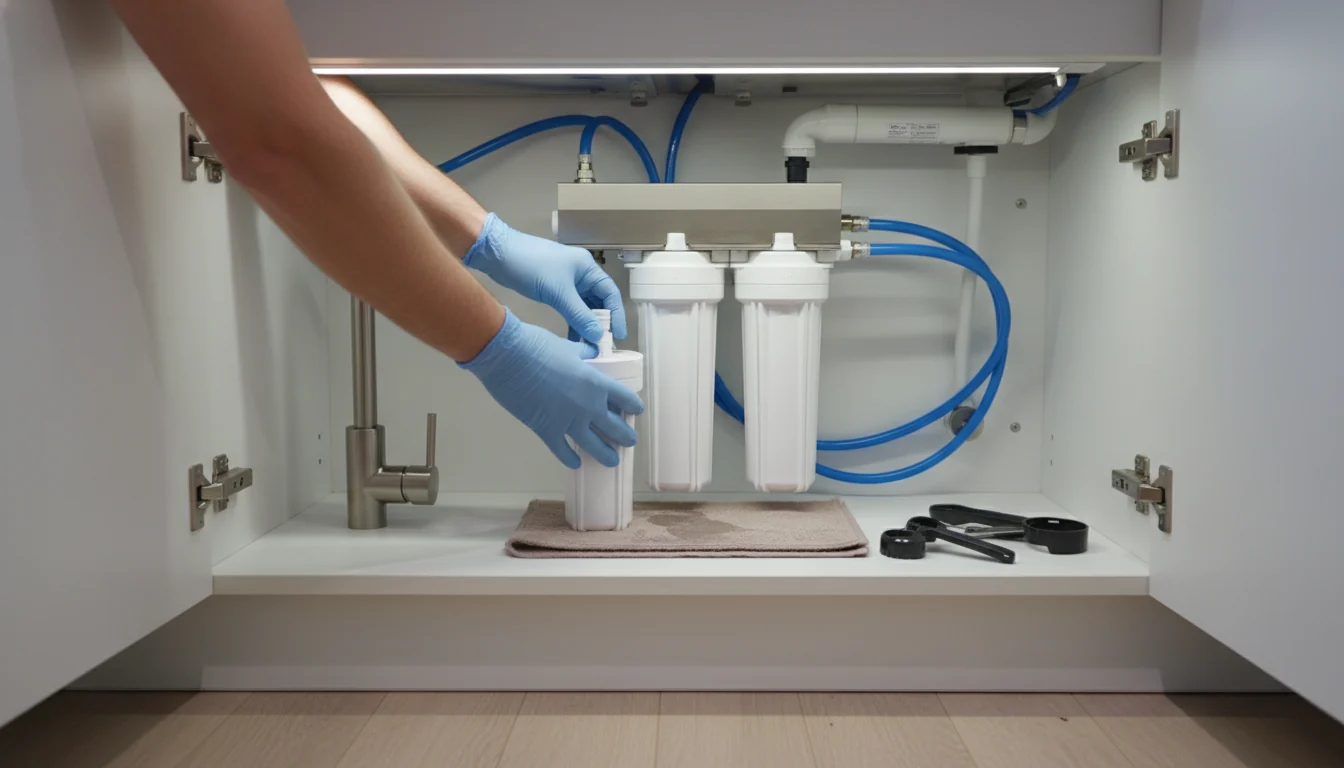
Under-sink filters
Under-sink systems usually offer better capacity than pitcher or faucet filters because they have more room for larger cartridges. A single-stage carbon block may run six months to a year in many homes, but heavily chlorinated or sediment-heavy water can shorten that.
If the system has multiple stages, each stage may have a different schedule. A sediment prefilter might need replacement before a carbon block. Replacing all stages on the same day is simple, but not always required. The manual should spell this out.
Reverse osmosis systems
Reverse osmosis systems need more than one maintenance schedule. The sediment and carbon prefilters protect the RO membrane. If those prefilters are neglected, the membrane can foul sooner or be exposed to chlorine it was not designed to handle.
Typical maintenance includes:
- Sediment prefilter: often every 6–12 months.
- Carbon prefilter: often every 6–12 months.
- Carbon postfilter: often every 6–12 months.
- RO membrane: often every 2–5 years.
A TDS meter can help track RO performance, but it does not detect every contaminant and should not replace the manufacturer’s maintenance schedule. If the system has a storage tank, sanitizing procedures may also be recommended during filter changes.
Whole-house filters
Whole-house systems treat water before it reaches fixtures. Because they handle showers, laundry, toilets, outdoor spigots, and everything else unless bypassed, they can see much higher flow than drinking-water filters.
Sediment filters may need frequent changes if your water carries sand, rust, silt, or well sediment. A pressure drop at fixtures can be a clue. If you have pressure gauges before and after the filter housing, a growing pressure difference is a better clue.
Whole-house carbon systems vary widely. Some use replaceable cartridges; others use large media tanks. Follow the specific system guidance and avoid assuming all “whole-house carbon” units have the same lifespan.
How to build a simple replacement schedule
You do not need a complicated spreadsheet. A reliable system can be very simple.
- List every filter in the home. Include fridge, pitcher, shower, under-sink, RO, whole-house, humidifier, and ice maker filters.
- Record the model number. This prevents ordering the wrong cartridge later.
- Write down rated gallons and time interval. Use the shorter of the two as your default.
- Add the install date. Put it on the filter housing with painter’s tape or in a phone reminder.
- Set reminders early. A reminder one or two weeks before the due date gives you time to order replacements.
- Keep one spare on hand. This is especially helpful for proprietary refrigerator and under-sink cartridges.
For filters protecting a more expensive component, such as an RO membrane, err on the side of timely replacement. A low-cost prefilter can help protect the more expensive membrane downstream.
Should you replace a filter early?
Sometimes, yes. Replace early if:
- Your water has changed after plumbing work, hydrant flushing, flooding, or well disturbance.
- The filter was installed before a long vacancy and sat unused.
- You see heavy discoloration in a sediment cartridge.
- Taste or odor returns before the scheduled date.
- Flow becomes inconveniently slow.
- The filter is used for a baby formula station, medical need, or another situation where extra caution is appropriate.
Replacing early is not wasteful if the filter is clearly clogged or performance has changed. The goal is not to squeeze every last day out of the cartridge; it is to keep the system working predictably.
What happens if you use a filter too long?
The most common outcome is reduced performance. Water may move slowly, taste worse, or bypass treatment if the system is not properly sealed. In some systems, a clogged filter can also reduce pressure enough to affect connected appliances.
There is also a trust problem. Filter claims are tied to tested conditions and rated capacity. Once a filter is far beyond its rating, you cannot confidently assume the same reduction performance. That matters most when your concern is a contaminant with health significance.
If you discover an old filter, replace it, flush the new one as directed, and consider whether any downstream parts need cleaning or sanitizing. For RO systems, check whether the tank or lines should be sanitized during service.
Buying replacement filters: OEM vs compatible
Original equipment manufacturer filters are usually the safest compatibility choice, but they can be expensive. Compatible filters may be fine if they are well-made, properly certified for the claims you need, and designed for your exact model.
Before buying, check:
- Exact model compatibility.
- Certification or test claims for your target contaminants.
- Return policy in case the fit is wrong.
- Reviews mentioning leaks, poor fit, or short life.
- Whether the cartridge includes seals or O-rings.
For refrigerator filters in particular, fit matters. A cartridge that clicks in but does not seal correctly can leak or allow untreated water to pass. If you are buying a non-OEM replacement, be selective.
Final recommendation
If you want the simplest answer: replace your water filter at the manufacturer’s rated gallons or time limit—whichever comes first. Then replace sooner if flow slows, taste or odor returns, or your water quality changes.
For most households, the easiest maintenance upgrade is not a better gadget. It is a visible replacement date, a phone reminder, and one spare cartridge in the cabinet. That small routine keeps your filter from becoming something you only remember after the water starts tasting off.