
You’ve seen the headline that boiling water removes up to 90% of microplastics, and now you’re eyeing the case of bottled water in your pantry. Before you start boiling it on the stove, you should know what that number was actually measuring.
Quick answer: Usually not. The 90% figure came from hard tap water that was boiled and then strained, and the study never tested bottled water. For most bottled water, a certified filter is a far better bet than a pot.
Does Boiling Water Remove Microplastics in Bottled Water?
Usually not. Boiling alone isn’t a reliable fix, and the famous 90% result applies only to mineral-rich hard water that was boiled and then filtered. Nobody in that study boiled a bottle of store-bought water.
Soft or low-mineral water did much worse in the same research, with roughly 25% removal. Many bottled waters, especially purified and distilled ones, are low in minerals, which puts them closer to the soft-water end. Tap Score, a water-testing company, states plainly that boiling does not remove microplastics.
The sections below cover what the study did, why hardness matters, a boiling method if you still want to try it, and what works better.
What Are Microplastics, and Are They in Bottled Water?
Microplastics are plastic particles between 1 micron and 5 millimeters, and nanoplastics are anything smaller than 1 micron. They turn up in both tap and bottled water, and you can’t see, smell or taste them.
The top of that range is roughly a sesame seed. Since 1 millimeter equals 1,000 microns, the smallest particles are thousands of times thinner. Nanoplastics are smaller than a red blood cell (about 6 to 7 microns) and fall in the size range of bacteria (around 2 microns).
The particles come from car tires, fleece sweaters, packaging and plenty of other plastic items. They’ve been found in food, drinking water and air. Researchers have also found them in blood, breast milk and the lungs of people undergoing surgery.
What that means for your health is still being worked out. Research increasingly indicates that plastic particles may build up in body tissues and set off inflammation and cellular stress, and certain laboratory experiments have found harm to human cells. Scientists are only beginning to understand the actual risks. That’s a reason to cut exposure where it’s easy, not a reason to panic.
One more catch: you can’t check your own water. Only a certified lab can test for microplastics, and no at-home test strips can identify them.
What Did the 90% Microplastics Study Actually Test?
A February 2024 study in Environmental Science & Technology Letters boiled tap water from Guangzhou, China that researchers had deliberately spiked with nano- and microplastics. It didn’t test bottled water at all.
The team boiled each sample for five minutes and let it sit for 10 minutes to cool. Because they added the plastic themselves at varying levels, this was a controlled lab setup, not a measurement of what’s really floating in a store-bought bottle. Healthline’s coverage summarizes the finding that boiling mineral-rich water can cut exposure by up to 90%.
The authors framed boiling as a cheap, accessible option, especially for places where costlier filtration is out of reach. That’s a reasonable pitch. It’s a very different claim from “boil your bottled water and it’s clean.”
The bigger problem is what got lost in the retelling. The method includes a filtering step, and the Yale E360 headline says so directly: boiling, then filtering. Many shorter headlines dropped that second half, and the second half is where the plastic actually leaves the water.
Why Does Boiling Hard Water Remove More Microplastics?
Hard water contains calcium and magnesium, which form limescale (calcium carbonate) as it boils. Those flecks trap plastic particles, but only straining them out removes the plastic from your drink.
Here’s the difference in numbers. Boiling soft water removed only around 25% of microplastics, while hard water removed as much as 90%. The approach simply works better when there’s a lot of dissolved mineral to form scale.
The trapped particles don’t vanish. They end up inside the limescale, and the flecks are big enough to catch with an ordinary coffee filter. If you pour the boiled water straight into a cup without straining, you’re still drinking much of what the scale grabbed, because it’s floating or settling right there in the pot.
Low-mineral water gives the process little to work with. With less calcium carbonate forming, there’s less to trap anything. And boiling never destroys plastic, it only changes where the particles are sitting.
Is Your Bottled Water Hard Enough for This to Work?
Probably not if it’s purified or distilled, since those are low in minerals by design. Spring and mineral waters with more calcium and magnesium are more likely to form limescale, but nobody has tested whether that translates into microplastic removal.
Here’s how to size up your bottle:
- Read the label. Look for calcium, magnesium and total dissolved solids (TDS). Higher numbers mean harder water. Many labels on purified water list none of these, which is a hint in itself.
- Watch the pot. If you see white, chalky scale after boiling, the water had some hardness. A clean pot suggests there was little to trap anything.
- Don’t assume a brand qualifies. No one has shown that the study’s results hold for any bottled brand.
- Accept that you can’t confirm it. No home test tells you whether microplastics came out. You’d be trusting a process you can’t verify.
If your water is hard tap water, you’re in a much better position than if you’re boiling purified bottled water. In that case, skip the bottles and treat your tap.
How Do You Boil and Strain Bottled Water If You Try It?
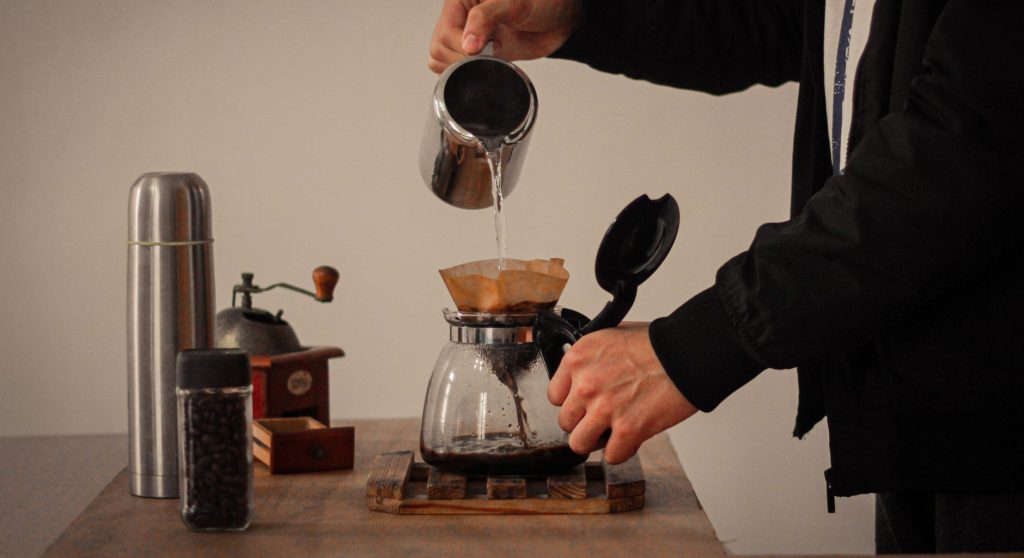
Boil the water for five minutes in a stainless steel or glass pot, cool it for 10 minutes, then pour it through a coffee filter into a glass container. This mirrors the study’s method, with the straining step included.
- Pick the right pot. Use stainless steel or glass cookware. A plastic kettle or lid that touches hot water can add its own plastic, which defeats the purpose.
- Boil for 5 minutes. Keep it at a rolling boil. Don’t boil it down much, since evaporation concentrates whatever else is dissolved in the water.
- Cool for 10 minutes. This gives the scale time to form and settle.
- Strain. Pour slowly through a clean paper coffee filter set in a dripper or sieve, into a glass jar. Stop before the last bit of water at the bottom, where the scale collects.
- Dump the residue. Rinse the limescale down the drain and toss the filter. Don’t reuse it, since it’s now holding the particles you just caught.
Be realistic about the payoff. With soft or low-mineral bottled water, you may spend 15 minutes and end up with water that’s only slightly cleaner, if at all. And paper filters aren’t certified for this job, so treat the result as a rough reduction, not a guarantee.
What Actually Removes Microplastics from Drinking Water?
According to Tap Score, microplastics can be filtered out by reverse osmosis systems, by microfiltration, ultrafiltration or nanofiltration, and by activated carbon filters that carry the right certification. Boiling alone can’t do this reliably.
If you want the best odds, Tap Score points to systems certified to NSF/ANSI 401 for microplastics. That certification matters because plenty of pitcher and faucet filters make vague claims without independent testing behind them.
| Method | Microplastic removal | What to know |
|---|---|---|
| Boiling alone | Not reliable | Particles stay in the pot; soft water saw about 25% in the study |
| Boiling plus coffee-filter straining | Up to 90% in hard water only | Lab result with spiked tap water; untested on bottled water |
| Reverse osmosis | Can remove them | Under-sink units cost more and send some water to the drain |
| Ultrafiltration or nanofiltration | Can remove them | Check the manufacturer’s testing and replacement schedule |
| Activated carbon certified to NSF/ANSI 401 | Can remove them | Tap Score’s top pick; look for the specific certification |
| Filtered tap water stored in glass or stainless steel | Depends on the filter | Also cuts how many plastic bottles you buy |
Before you buy, check three things. First, confirm the certification on the manufacturer’s listing or the certifier’s database, not just the box. Second, price out replacement cartridges, because the yearly cost often matters more than the sticker price. Third, if you’re looking at reverse osmosis, ask about the wastewater ratio, meaning how many gallons go down the drain for each gallon you drink.
Filtering your tap water and keeping it in glass bottles or a stainless steel bottle also takes single-use plastic bottles out of the picture. For most households, that’s the simplest long-term swap.
The Bottom Line: What to Do Next
Skip boiling as your main plan for bottled water. Put a certified filter on your tap, store the water in glass or steel, and treat boiling plus straining as a rough backup, useful mostly if your tap water is hard.
The better-supported route is certified filtration, not a pot on the stove. Health research on microplastics is still developing, so a sensible, low-cost reduction beats chasing a headline number.
Check current options, prices and reviews for reverse osmosis water filters side by side before deciding what fits your home best.
As an Amazon Associate, Clean Water In Homes may earn from qualifying purchases.
Frequently Asked Questions
Does boiling filtered water remove microplastics?
Probably little. Filtered water is often low in minerals, so less limescale forms to trap particles. Boiling doesn’t destroy plastic, so the quality of the filter matters more than the boil.
Which bottled water has the least microplastics?
No brand can be reliably ranked. Results vary by bottle, batch and lab method, and companies rarely publish independent testing. Treat any low-microplastic claim cautiously unless it’s backed by outside data.
Does boiling remove PFAS, heavy metals or fluoride?
No. Boiling doesn’t remove PFAS, and as water evaporates, metals and fluoride can become more concentrated. Use filters certified for those specific contaminants.
Is the limescale from boiling water harmful?
Limescale is calcium carbonate, which isn’t a health concern on its own. The reason to strain it out is that it holds the plastic particles it caught, so leaving it in your cup defeats the purpose.
Can you flush microplastics out of the body?
No proven method exists. The practical approach is to reduce exposure by filtering water, limiting plastic bottles and avoiding heating food or drinks in plastic.
Sources and further reading