
A water filter pitcher is one of the simplest ways to improve the taste of tap water without installing anything under the sink. You fill the top reservoir, wait for water to pass through the cartridge, and store the pitcher in the refrigerator or on the counter. For many households, that is enough to make daily drinking water more convenient and more pleasant.
But “best” depends on what you need the pitcher to do. Some pitchers are built mainly for chlorine taste and odor. Some target lead or other specific contaminants. Some filter quickly, while others trade speed for broader reduction claims. A pitcher that is perfect for a single apartment dweller may be frustrating for a family of five.
This buyer guide explains how to choose the best water filter pitcher for everyday home use, what features matter, what marketing claims to treat carefully, and which types of pitchers make sense for different households.
Quick picks by household need
Because filter models change often, this guide focuses on buying categories rather than pretending one product is always best for everyone. Use these categories to match a pitcher to your situation.
- Best for basic taste improvement: a certified activated carbon pitcher for chlorine taste and odor.
- Best for older plumbing concerns: a pitcher certified for lead reduction, if lead is a realistic concern in your home.
- Best for chloramine taste: a pitcher specifically tested for chloramine reduction.
- Best for families: a large-capacity dispenser or high-capacity pitcher with affordable replacement filters.
- Best for small refrigerators: a slim pitcher that fits in the door or a compact shelf space.
- Best for low-maintenance users: a pitcher with long-life filters and a clear replacement indicator.
- Best for renters: a no-install pitcher or countertop dispenser that does not require plumbing changes.
What a water filter pitcher can realistically do
Most water filter pitchers use activated carbon, ion exchange resin, or a combination of media. Depending on the design and certification, a pitcher may reduce chlorine taste and odor, some metals, certain organic compounds, and specific contaminants listed by the manufacturer.
The important word is “specific.” A pitcher does not automatically remove everything just because it has a filter. Each product should be judged by its tested reduction claims.
A good pitcher can often help with:
- Chlorine taste and odor.
- Some earthy or musty tastes, depending on cause.
- Certain metals if certified for them.
- Some contaminants listed in the performance data sheet.
- Sediment or particles if the design includes suitable filtration.
A pitcher may not be the right tool for:
- Microbiologically unsafe water.
- Boil water advisories.
- Severe contamination events.
- Whole-house hard water scale.
- High-volume cooking and appliance water needs.
- Private well problems that have not been tested.
If your water may be unsafe, do not rely on a basic pitcher as your only treatment. Follow local health guidance and use a system certified for the specific issue.
Start with your water, not the pitcher
The best water filter pitcher is the one that matches your tap water. Before buying, ask what you are trying to improve.
If your water tastes like a pool, chlorine or chloramine may be the issue. If it tastes metallic, plumbing or source water conditions may be involved. If you live in an older home with older service lines or plumbing materials, lead may be a concern worth investigating. If you use a private well, you should test rather than guessing.
For city water, check your utility’s Consumer Confidence Report. It can tell you about the water source, disinfectant, and regulated contaminants. It may not answer every household plumbing question, but it is a useful starting point.
For private wells, the homeowner is responsible for testing and treatment decisions. A pitcher can improve taste, but it should not replace appropriate well testing for bacteria, nitrate, arsenic, lead, or local concerns.
Certifications matter more than vague claims
Water filter packaging can be full of confident language: clean, pure, advanced, premium, refreshing. Those words are less useful than independent certification and a detailed performance data sheet.
Look for references to NSF/ANSI standards and certification by organizations such as NSF, WQA, or IAPMO. The exact standard matters because different standards address different claims. Do not assume a pitcher certified for chlorine taste is also certified for lead, PFAS, chloramine, or any other concern unless the product specifically says so.
Pitcher types to consider
Water filter pitchers are not all shaped or used the same way. The right format depends on your refrigerator space, household size, and patience level.
Standard refrigerator pitchers
These are the classic pitchers with a top reservoir and a pour spout. They are easy to store, easy to refill, and familiar to most people.
Best for:
- One to three people.
- Basic drinking water.
- Small kitchens.
- Refrigerator storage.
Watch for:
- Small capacity if several people drink filtered water.
- Slow filtration when the reservoir is empty.
- Lid designs that fall off while pouring.
Large-capacity dispensers
A dispenser sits on a refrigerator shelf or counter and uses a spigot instead of a pour handle. It holds more water than many pitchers.
Best for:
- Families.
- People who fill bottles often.
- Shared offices or dorm-style setups.
- Anyone tired of refilling a small pitcher.
Watch for:
- Refrigerator shelf clearance.
- Spigot durability.
- Cleaning around the dispenser valve.
Slim pitchers
Slim pitchers are designed for narrow refrigerator doors or tight shelves. They sacrifice capacity for fit.
Best for:
- Apartments.
- Dorm rooms.
- Small refrigerators.
- Single-person households.
Watch for:
- Frequent refilling.
- Smaller handles and reservoirs.
- Whether the pitcher is stable when full.
Premium contaminant-reduction pitchers
Some pitchers are designed for broader contaminant reduction claims, such as lead, PFAS, or other specific substances. These may use more complex media and may filter more slowly.
Best for:
- Homes with a specific tested concern.
- Renters who cannot install under-sink filtration.
- People who prioritize reduction claims over speed.
Watch for:
- Higher replacement filter cost.
- Slower flow.
- More frequent cartridge changes depending on capacity.
Key features that actually matter
A pitcher is a simple product, but details affect whether you keep using it.
Filter certification and performance sheet
This is the first thing to check. The performance data sheet should list what the filter is tested or certified to reduce and for how many gallons or months.
If you cannot find the performance sheet, that is a warning sign. Good manufacturers make reduction claims easy to verify.
Replacement filter cost
The pitcher price is only the beginning. Replacement cartridges determine the real long-term cost.
Before buying, check:
- Filter life in gallons and months.
- Cost per replacement cartridge.
- Multi-pack availability.
- Whether generic replacements are acceptable or certified.
- Whether the filter must be soaked, flushed, or primed.
A cheap pitcher with expensive short-life filters may cost more over time than a higher-priced pitcher with longer-life cartridges.
Capacity
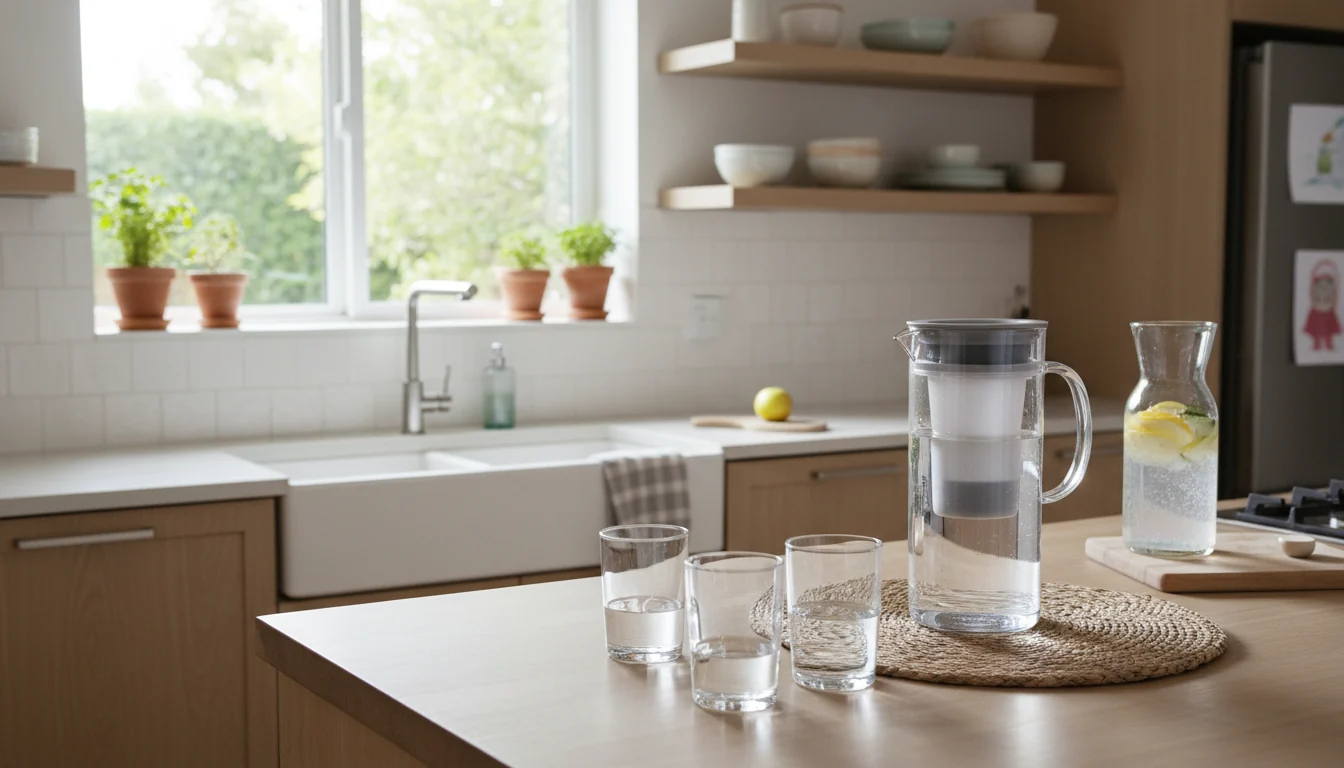
Capacity has two meanings: total pitcher volume and filtered water volume. Some pitchers look large but have a small filtered reservoir. If your household drinks a lot of water, choose a larger pitcher or dispenser.
For families, capacity is often more important than style. If the pitcher is always empty, people stop using it.
Filtration speed
Fast filtration is convenient, but speed is not the only goal. Some filters that target more contaminants may flow more slowly. That is not automatically bad, but it should fit your routine.
Ease of cleaning
Pitchers need cleaning. Water sits in them, hands touch lids and handles, and refrigerator odors can collect over time.
Look for:
- A wide opening.
- A lid that removes easily.
- Smooth surfaces without grime traps.
- Dishwasher-safe parts, if offered.
- A spout or dispenser valve that can be cleaned.
Always follow the manufacturer’s cleaning instructions. Do not put filter cartridges in the dishwasher.
Filter replacement indicator
A reminder light, dial, or app is helpful, but it is not magic. Some indicators are based on time, some on estimated use, and some are manual. If your household uses more water than average, you may need to replace cartridges sooner.
A filter past its rated life may not provide the same reduction performance. Set a calendar reminder if the built-in indicator is easy to ignore.
Comparison guide: which pitcher style fits you?
| Household situation | Better pitcher style | Why it fits |
|---|---|---|
| One person in a small apartment | Slim pitcher | Saves refrigerator space and is easy to refill |
| Family with kids | Large dispenser | Higher capacity and less frequent refilling |
| Chlorine taste only | Basic certified carbon pitcher | Usually cost-effective for taste and odor |
| Lead concern | Lead-certified pitcher | Targets a specific health-related contaminant claim |
| Very limited fridge space | Countertop dispenser or slim pitcher | Avoids bulky standard pitcher storage issues |
| Low patience for slow filtering | Faster-flow pitcher or larger reservoir | Keeps filtered water available ahead of demand |
Tables can simplify the decision, but always verify current product claims before buying. Manufacturers can change filter designs, certifications, and replacement cartridges.
Best water filter pitcher categories
Below are the main categories I would consider for everyday home use.
Best basic pitcher for chlorine taste
Choose this if your tap water is generally safe but tastes or smells like chlorine. Look for a pitcher certified for chlorine taste and odor reduction. Activated carbon is commonly used for this purpose.
What to prioritize:
- NSF/ANSI certification for chlorine taste and odor.
- Affordable replacement filters.
- Good pouring design.
- A size that fits your refrigerator.
What not to overpay for:
- Broad contaminant claims you do not need.
- Fancy electronics that do not improve filtration.
- Oversized pitchers that will not fit your fridge.
This is often the best starting point for city-water households that simply want better tasting water.
Best pitcher for lead concerns
If lead is a concern, do not buy based on taste alone. Lead is not reliably detected by taste, smell, or appearance. Look for a pitcher certified for lead reduction and review the performance data sheet carefully.
A lead-reduction pitcher may be a practical option for renters or as a temporary measure while investigating plumbing. However, it should be part of a broader plan if testing shows elevated lead. You may need to address service lines, fixtures, flushing practices, or other treatment options.
What to prioritize:
- Certification for lead reduction.
- Clear filter life rating.
- Strict replacement schedule.
- Proper flushing and setup instructions.
Do not stretch filter life with lead concerns. Replace cartridges as directed.
Best pitcher for chloramine taste
Chloramine is more persistent than free chlorine and may not improve much from simply letting water sit. If your utility uses chloramine and you dislike the taste, choose a filter that specifically mentions chloramine reduction.
What to prioritize:
- Chloramine reduction claim, ideally independently certified or tested.
- Enough contact time or media design for the claim.
- Realistic expectations about flow speed.
If you are unsure whether your water uses chlorine or chloramine, check your utility report or contact the water provider.
Best large-capacity option for families
For families, capacity can matter more than sleek design. A dispenser with a spigot can keep enough filtered water ready for glasses, bottles, and cooking tasks.
What to prioritize:
- Large filtered-water capacity.
- Stable refrigerator fit.
- Easy-to-clean spigot.
- Affordable multi-pack filters.
- Durable lid and reservoir.
A large dispenser can be awkward to refill when full, so check whether it fits under your faucet and in your refrigerator before committing.
FAQs About Water Filter Pitchers
Are water filter pitchers worth it?
They can be worth it if your main goal is better-tasting tap water and a simple, low-cost setup. They are less ideal when you need high-volume filtration or have a specific contaminant that requires a stronger certified system.
Do pitcher filters remove microplastics?
Some pitchers make particle or microplastic-related claims, but you need to check the exact cartridge data rather than assuming all pitchers perform the same. Certifications and test reports matter more than broad marketing.
How often should I replace a water pitcher filter?
Follow the cartridge schedule from the manufacturer, then adjust for heavy use or obvious taste changes. An old filter can slow down, taste stale, and stop giving the performance you bought it for.
Is a pitcher better than an under-sink filter?
A pitcher is cheaper and easier to start with. An under-sink filter is usually better for higher daily use, faster flow, and households that want filtered water without constantly refilling a jug.
Best compact option for small refrigerators
If your fridge is small, the best pitcher is the one that actually fits. A slim pitcher may require more refilling, but it is better than a bulky pitcher that lives on the counter and warms up.
What to prioritize:
- Door fit or narrow shelf fit.
- Comfortable handle.
- Secure lid.
- Easy filling under a small sink faucet.
Measure your refrigerator space before buying. Product photos can make pitchers look smaller than they are.
Common buying mistakes
Avoid these mistakes when choosing a water filter pitcher.
Mistake 1: Buying for “removes everything” claims
No pitcher removes everything. Look for specific certified reductions. If the claim sounds too broad, read the fine print.
Mistake 2: Ignoring replacement filters
If cartridges are expensive, hard to find, or short-lived, you may stop replacing them. An unmaintained filter is not a bargain.
Mistake 3: Choosing too small
A tiny pitcher can work for one person. For a family, it may be empty all day. Match capacity to actual use.
Mistake 4: Assuming a pitcher softens water
Most water filter pitchers are not water softeners. They may improve taste and reduce certain contaminants, but they generally will not solve hard water scale throughout the bathroom or kitchen.
Mistake 5: Using a pitcher during safety advisories
If your water provider issues a boil water advisory or do-not-drink notice, follow the official instructions. A standard pitcher is not a substitute for emergency guidance.
Maintenance tips for better results
A pitcher works best when it is maintained properly.
- Wash the pitcher regularly according to the manufacturer’s instructions.
- Replace filters on schedule.
- Store filtered water in the refrigerator unless the product allows countertop use.
- Keep the lid closed to reduce dust and food odors.
- Do not run hot water through the filter unless the manufacturer says it is allowed.
- Flush or prime new cartridges as directed.
- Replace cracked pitchers or damaged reservoirs.
If filtered water starts tasting stale, clean the pitcher and check the filter date. Refrigerator odors can also affect water taste, especially if the pitcher is uncovered or the spout is exposed.
Pitcher versus faucet filter versus under-sink filter
A pitcher is not the only option. It is just the easiest to start with.
Choose a pitcher if:
- You rent.
- You want no installation.
- You mainly filter drinking water.
- You have limited budget.
- You want something portable.
Choose a faucet filter if:
- You want filtered water on demand.
- Your faucet is compatible.
- You do not mind a fixture attachment.
- You use more water than a pitcher can conveniently supply.
Choose an under-sink filter if:
- You want a cleaner countertop.
- You filter a lot of cooking and drinking water.
- You are comfortable with installation.
- You want higher capacity and dedicated cartridges.
Pitchers are excellent for convenience and low commitment. If you constantly refill yours, that may be a sign you are ready for a larger system.
Final buying checklist
Before you buy, answer these questions:
- What problem am I trying to solve: taste, lead, chloramine, PFAS, or something else?
- Is my water from a city system or a private well?
- Does the pitcher have third-party certification for my concern?
- What is the cartridge replacement cost per year for my household?
- Will the pitcher or dispenser fit my refrigerator?
- Is the capacity enough that people will actually use it?
- Can I clean it easily?
- Are replacement filters easy to find?
- Does the filter life match my realistic use?
- Do I need a bigger system instead?
Bottom line
The best water filter pitcher for everyday home use is not always the most expensive one. It is the pitcher that matches your water, fits your kitchen, has credible reduction claims, and is easy enough to maintain that you will keep using it.
For many city-water households, a certified carbon pitcher for chlorine taste and odor is a practical starting point. If you have specific concerns such as lead, chloramine, PFAS, or private well water, choose based on testing and certification rather than broad marketing language.
A pitcher will not solve every water problem, but it can be a smart, affordable step toward better-tasting daily drinking water.