
Yes, some home filters work, but only certain types do. Plenty of common fixes, including boiling, water softeners and many pitchers, won’t help at all.
Quick answer: PFAS filters work when they use reverse osmosis, quality activated carbon or PFAS-designed ion exchange resin and are certified to NSF/ANSI 53 or 58 for PFOA and PFOS (or total PFAS). They reduce PFAS but never remove 100%. Test your water first, because if PFAS aren’t there, you may not need a filter at all.
Do PFAS Water Filters Really Work?
Yes, certain ones do. The EPA says a home filter can be an effective way to lower PFAS, with a catch: not every filter is built to handle them, so pick one certified for PFAS.
The word that matters is “reduce.” Even good filters lower PFAS rather than wipe them out. Researchers at Duke University and NC State University found that PFAS can slip through many filters, while reverse osmosis and two-stage designs held up best.
The other thing to know up front: a filter only helps if there’s something to filter. If your water has no detectable PFAS, you’d be paying for protection you don’t need. The next two sections cover what PFAS are and how to find out where your water stands.
What Are PFAS and Why Are They in Tap Water?
PFAS are thousands of man-made “forever chemicals” that repel oil and water and resist heat. Because they barely break down, they build up in soil and water, and eventually some reach drinking supplies.
You’ll find them in nonstick pans, food packaging, waterproof jackets, stain-resistant furniture and firefighting foam. The Guardian reported in 2021 that roughly 4,700 different chemicals fall under the PFAS umbrella, with suspected links to cancer, heart disease, liver disease, birth defects and a weaker immune system. The same reporting cited studies suggesting the drinking water of well over 100 million people may be contaminated, and estimated that PFAS show up in the blood of 97% of Americans.
Tap water isn’t the only source, but the EPA notes it can be a significant share of a person’s total exposure. That’s why filtering the water you drink and cook with is the most practical place to start.
Do I Need a PFAS Filter at All?
Not always. If your water shows no PFAS, or levels below federal limits, the EPA says a filter may not be worth buying. Find out what’s in your water before you spend anything.
- City water: Contact your local water provider and ask which PFAS, if any, are in your supply. The EPA also runs a searchable database of water system PFAS test results, plus its PFAS Analytic Tools.
- State resources: Your state health agency may publish its own data and guidance on home treatment.
- Private wells: There’s no utility report, so you need a lab test. Do this first, especially if your well is near a known PFAS source such as a firefighting foam site or a landfill.
Here’s the quick rule. PFAS not detected or below limits: you can probably skip the filter. Above limits, or a well near a likely source: buy a certified filter.
One caveat. If you’re simply uneasy and want extra margin, a certified point-of-use filter is a reasonable, low-risk choice. Just don’t expect it to fix a problem you haven’t confirmed.
Which Types of Filters Remove PFAS?
Three technologies do the job: reverse osmosis, good activated carbon and ion exchange resin made for PFAS. The Minnesota Department of Health says carbon and reverse osmosis have been shown to be effective when properly installed and maintained.
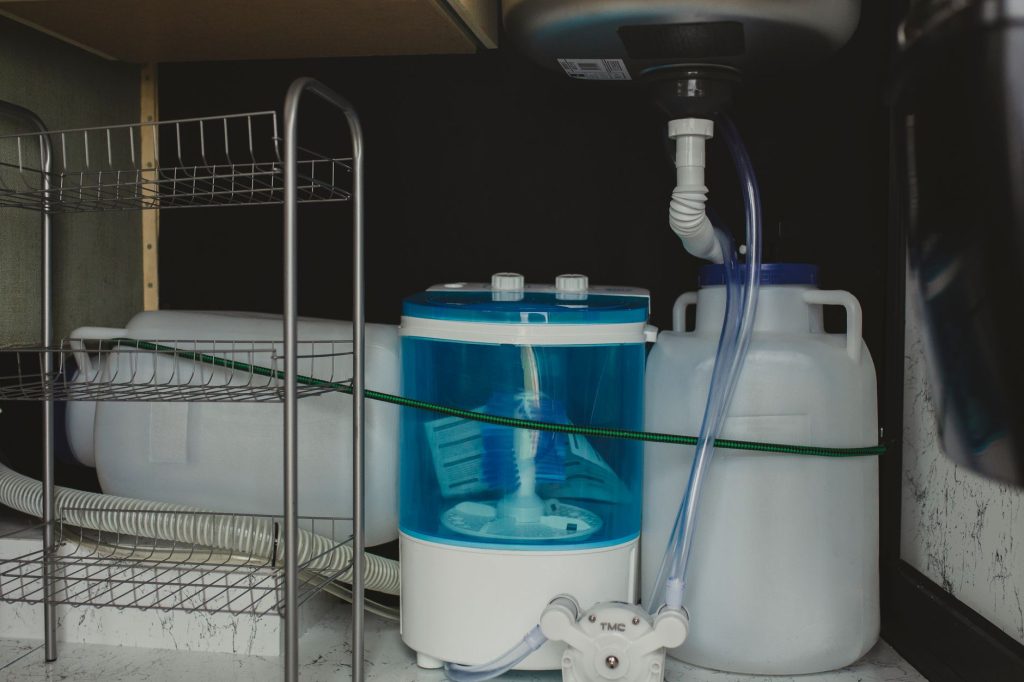
Activated carbon. Carbon is the most common type in homes, and it’s also the most inconsistent. Some carbon filters remove nearly all PFAS and others do nothing, and contact time is a big reason. Water needs to spend enough time in the carbon, and the filter has to be fresh. Granular activated carbon (GAC) cartridges turn up in pitchers, faucet filters and under-sink units.
Reverse osmosis. RO pushes water through a membrane with tiny pores that block PFAS. It’s more practical at a single tap than for a whole house, so you’ll mostly see it as a countertop or under-sink unit.
Ion exchange resin. These resins attract contaminants to tiny beads so they can’t pass through. Some are designed specifically for PFAS, and you’ll see them in certain whole-house and PFAS-focused systems.
Two-stage filters. Pairing activated carbon with another stage also performed well in the Duke and NC State work, so it’s a good sign when a product combines them.
Then there’s where to install it. Point-of-use treatment (one faucet) tends to cost less than point-of-entry (whole home). Well owners with high test results might justify whole-house treatment, but test first and consider whether filtering only your drinking and cooking water is enough.
Do Brita Pitchers, Boiling, or Softeners Work?
Usually not. Boiling, water softeners and iron filters don’t remove PFAS, and most standard pitchers aren’t certified for them. Only a model with a PFAS claim on its label counts.
Boiling is the one that surprises people. As water evaporates, the chemicals can end up more concentrated in what’s left in the pot.
Softeners and iron filtration systems are a similar dead end. Sampling data show they don’t remove PFAS, so if you already own one, count on it for hardness or rust and nothing more.
For pitchers, check, don’t assume. Brita makes many filters, and a PFAS claim has to be printed on that specific model and backed by a certification. The same goes for any uncertified filter. It might help, but you can’t know, and given how many filters let PFAS through, that’s a gamble you don’t need to take.
How Can I Tell If a Filter Is Certified for PFAS?
Look for NSF/ANSI 53 or 58 certification that names PFOA and PFOS (or total PFAS), then confirm it in the certifier’s database. The label alone isn’t enough, since vague wording is common.
- Read the package closely. You want “PFOA/PFOS reduction” or “total PFAS reduction.” A line like “removes contaminants” or “reduces chemicals” tells you nothing.
- Confirm the standard and certifier. NSF/ANSI 53 covers many carbon filters, and NSF/ANSI 58 covers reverse osmosis. Certifiers include NSF, IAPMO and WQA.
- Look up the model number. Search it in the certifier’s online database to verify the claim. Brands sell many similar-looking filters, and only specific models carry the certification.
Keep expectations realistic. Certification means a tested reduction, never 100%. And as of April 2024, certifications focus on PFOA and PFOS, two specific PFAS, so they don’t cover every compound in the family.
PFAS Filter Types Compared at a Glance
This table shows which setups reduce PFAS, what to check on the label, rough cost and upkeep. Most certified claims cover PFOA and PFOS only, as of April 2024.
| Setup | Reduces PFAS? | What to look for | Cost | Upkeep |
|---|---|---|---|---|
| Pitcher | Depends | PFAS certification, such as ZeroWater (total PFAS) or Clearly Filtered (PFOA/PFOS) | ZeroWater is under $25 upfront | Replace cartridge on schedule |
| Faucet-mount | Depends | NSF/ANSI 53 PFAS claim for the exact model | Low end of the range | Replace cartridge on schedule |
| Countertop RO | Yes, if certified | AquaTru Carafe is IAPMO certified to NSF/ANSI 53 for PFOA and PFOS | Mid-range | Periodic filter changes |
| Countertop gravity | Yes, if certified | Culligan MaxClear carries IAPMO NSF/ANSI 53 for total PFAS | Mid-range | Periodic filter changes |
| Under-sink RO | Yes, if certified | NSF/ANSI 58 or 53; Waterdrop G3 P800 is one example | Higher upfront; about $0.11 per gallon for Waterdrop filters | Multiple cartridges and a membrane |
| Whole-house carbon | Depends | PFAS-specific certification and enough contact time | Highest range, can exceed $1,000 | Media or cartridge changes |
| Ion exchange | Depends | Resin designed for PFAS | Varies by system | Resin replacement |
| Water softener | No | Not designed for PFAS | n/a | n/a |
| Boiling | No | Can concentrate PFAS | Free | n/a |
What Do PFAS Filters Cost to Own and Maintain?
Expect to pay anywhere from $20 to more than $1,000 upfront, according to the EPA, and that doesn’t include maintenance. A spent filter stops protecting you, so replacement cartridges are part of the real price.
Pitchers and faucet filters are the cheapest to buy. Under-sink RO costs more at the start, and whole-house systems sit at the top of the range. The ZeroWater pitcher, certified for total PFAS, costs under $25 upfront, according to Water Filter Guru.
Look at running costs, not just the sticker price. Water Filter Guru puts the Waterdrop G3 P800 under-sink RO system at about $0.11 per gallon for filters. On the pitcher side, Clearly Filtered lists a 100-gallon filter life, five times the ZeroWater’s, so a pricier pitcher can come out even over time.
Replace cartridges on the maker’s schedule. The EPA calls maintenance critical, and a neglected unit gradually loses its ability to filter. Setting a phone reminder on install day is the cheapest insurance you can buy.
Is a PFAS Filter Worth It? The Bottom Line
A certified filter is worth it if your water tests above limits or you want extra margin. Otherwise, test first and skip the guesswork.
If you do buy one, make it a point-of-use unit at the tap you drink and cook from. Choose reverse osmosis or a carbon filter certified for PFOA/PFOS or total PFAS, verify the model number in the database, and change the cartridges on time.
Check current options, prices and reviews for pfas water filters side by side before deciding what fits your home best.
As an Amazon Associate, Clean Water In Homes may earn from qualifying purchases.
Frequently Asked Questions
Do PFAS filters also remove microplastics?
Not reliably. PFAS certification doesn’t test for microplastics. Reverse osmosis membranes block very small particles, but check the maker’s microplastic claims separately.
Do fridge filters remove PFAS?
Only if the specific fridge filter is certified for PFAS reduction. Most aren’t, so check the model number against the certifier’s database.
Do shower filters help with PFAS?
Most are not tested for PFAS. Drinking water is the main concern, so prioritize a certified filter where you drink and cook.
What should I do with used filters and RO wastewater?
Spent filters hold captured PFAS. Follow local disposal rules or the manufacturer’s guidance, and send RO wastewater down the drain as designed.
Should I cook and mix baby formula with filtered water?
Water you cook with goes into your food, so use certified-filtered water for both. Ask your pediatrician about infant formula.
Sources and further reading
- Reducing PFAS in Your Drinking Water with a Home Filter | US… (epa.gov)
- PFAS and Home Treatment of Water – MN Dept. of Health (www2cdn.web.health.state.mn.us)